What is a 3D Load Cell and How Does it Work?
The 3D Load Cell represents a significant advancement in weight measurement technology. It provides multi-dimensional sensing capabilities, allowing for precise analysis of loads in varied applications. Reports indicate that the global load cell market is expected to grow at a CAGR of 4.5% from 2021 to 2028. This growth reflects the increasing demand for accuracy in industrial processes.
Dr. Emily Sanders, a leading expert in sensor technology, emphasizes the importance of 3D Load Cells, stating, "Their ability to measure loads from multiple angles greatly enhances data reliability." This technology is particularly valuable in automated systems and robotics, where traditional load cells may fall short.
However, the adoption of 3D Load Cells is not without challenges. Companies must consider integration complexities and the learning curve associated with new technologies. Economic factors can also influence investment in 3D Load Cell systems, making it essential for businesses to evaluate their potential return on investment. As the industry evolves, collaboration between manufacturers and end-users will be crucial for overcoming these hurdles.
Definition and Basic Principles of a 3D Load Cell
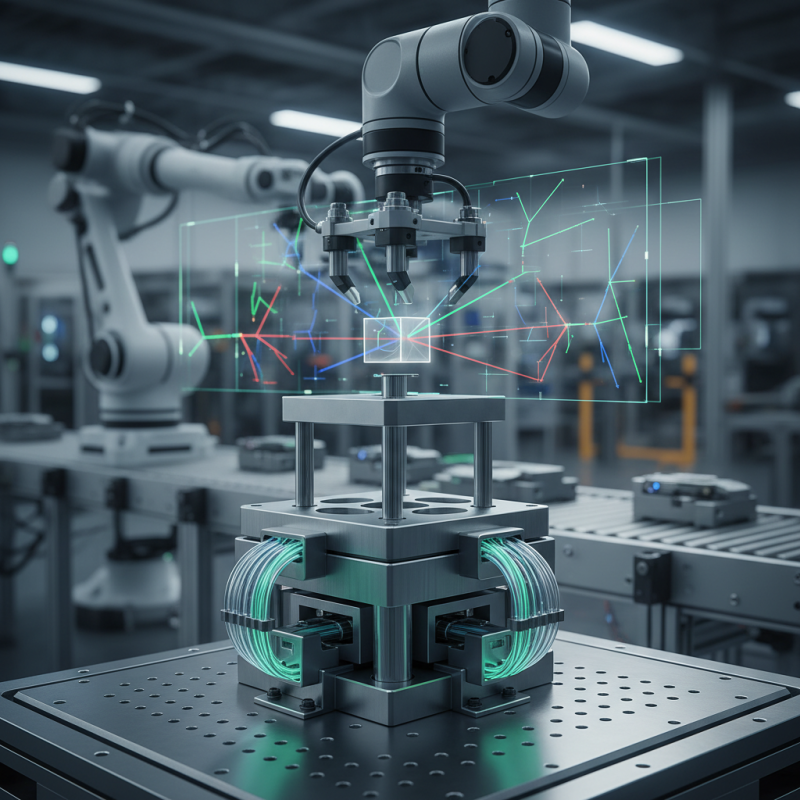
A 3D load cell is an advanced sensor used for measuring force. Unlike traditional load cells, it can detect force in three dimensions: X, Y, and Z axes. This capability allows for more comprehensive data collection, which proves vital in various applications, such as robotics and aerospace.
These load cells function based on the principle of strain gauges. When force is applied, the load cell deforms slightly. This deformation changes the electrical resistance of the strain gauges. The change can be measured and converted into data about the applied force. Engineers ensure they calibrate these sensors accurately to maintain precision, yet errors can still occur during this process.
Understanding the basic principles of a 3D load cell is crucial for proper application. However, achieving absolute accuracy remains challenging. Environmental factors, such as temperature and vibrations, may introduce errors. Designers must account for these elements when setting up a system. Thus, while 3D load cells are invaluable, their implementation can require careful thought and adjustment.
Key Components of a 3D Load Cell and Their Functions
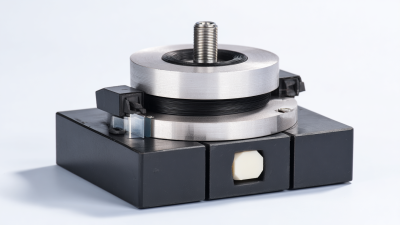
A 3D load cell is an advanced device that measures forces across three axes: X, Y, and Z. The key components include strain gauges, a housing unit, and electronics. Strain gauges are crucial, as they detect deformation when a load is applied. They convert mechanical stress into an electrical signal. This signal is then processed to determine the exact magnitude and direction of the load.
The housing unit protects the internal components. It is designed to withstand various conditions, such as moisture and temperature changes. Additionally, the electronics take the raw signals from the strain gauges. They amplify and convert these signals into usable data. According to a recent industry report, the global market for load cells is expected to grow at a CAGR of 7.5% through 2025, highlighting their increasing application.
Tips: Ensure proper calibration of your 3D load cell for accurate readings. Regular maintenance is essential to prolong its lifespan. Stay aware of your environment, as extreme conditions may impact performance. Real-world applications often reveal a gap in understanding the limits of load cells. A load cell might appear reliable, yet overloading could yield inaccurate results.
What is a 3D Load Cell and How Does it Work?
| Component |
Function |
Material |
Measurement Range |
| Load Cell Element |
Converts force to an electrical signal |
Aluminum |
0 - 2000 kg |
| Amplifier |
Amplifies the weak signal from the load cell |
Silicon |
N/A |
| Signal Conditioning Circuit |
Processes and filters the electrical signal |
Printed Circuit Board |
N/A |
| Output Interface |
Transmits the processed signal to a display or control system |
Metal |
N/A |
How a 3D Load Cell Measures Multi-Directional Forces
A 3D load cell is designed to measure forces in multiple directions. These sensors play a crucial role in industries like
robotics, automotive, and aerospace.
According to a recent industry report, the market for multi-directional load cells is expected to grow by 10.5% annually.
These load cells can capture forces along three axes: X, Y, and Z.
This capability allows for accurate readings when assessing complex interactions.
For example, in robotics, understanding how a robot interacts with its environment is vital for programming and safety measures.
The precision of these measurements can impact a project's success.
However, challenges remain. Calibration is critical and often requires specialized equipment.
Many professionals struggle with ensuring consistent stability during measurements.
A small error can lead to significant data discrepancies. This ongoing need for improvement underscores the
evolving nature of load cell technology and its applications.
Applications of 3D Load Cells in Various Industries
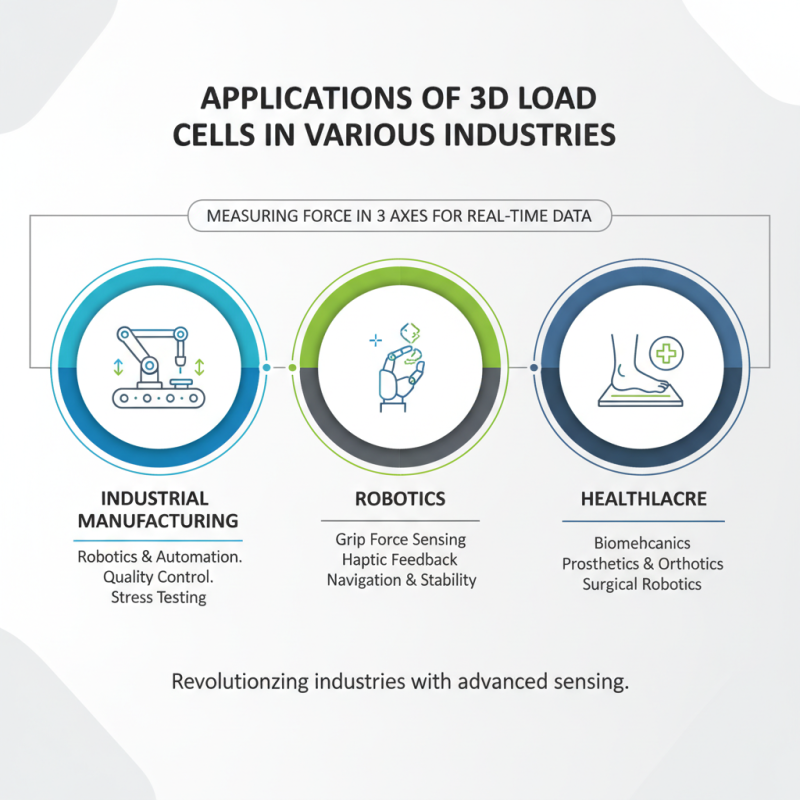
3D load cells are revolutionizing various industries with their advanced capabilities. These devices measure force along three axes. They provide accurate data in real-time. Their applications range from industrial manufacturing to robotics and healthcare.
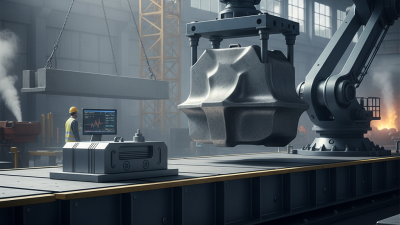
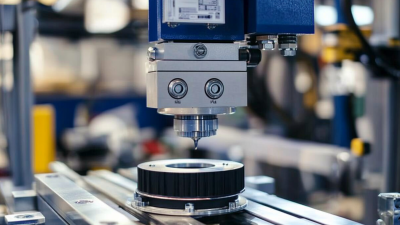
In manufacturing, they ensure quality control. A study shows that implementing 3D load cells can reduce production errors by up to 20%. This improvement boosts productivity significantly. In robotics, they enhance automation processes by providing precise load data for each movement. In healthcare, 3D load cells aid in patient monitoring. They can detect subtle changes in weight, which is crucial for treatment adjustments.
Tips: Always consider the environment. The placement of 3D load cells can affect their accuracy. Ensure they are mounted securely. Calibration is vital for reliable data. Regular check-ups can prevent inaccuracies. Remember, even the best technology needs maintenance. Small oversights can lead to significant issues in data integrity.
Advantages of Using 3D Load Cells Compared to Traditional Load Cells
3D load cells represent a significant advancement in load measurement technology. Unlike traditional load cells, which measure force in a single direction, 3D load cells capture data in three dimensions. This capability allows for more comprehensive analysis of forces and moments applied to a structure. The ability to measure multi-axis loads increases precision and efficiency in various applications, such as robotics and structural testing.
The advantages of 3D load cells are substantial. Reports show that they can enhance measurement accuracy by up to 20%. This improvement is crucial in industries where safety and reliability are paramount. Traditional load cells may miss critical data when forces act at angles or in multiple directions. A 3D load cell mitigates this issue by providing real-time data across all axes, helping engineers make informed decisions.
Additionally, using 3D load cells can reduce testing times. They allow for quicker iterations of design processes. However, they can come with a steeper learning curve for users unfamiliar with multi-axis systems. Ensuring that teams are trained to interpret the data effectively is essential. Without proper understanding, the benefits can be lost, leading to miscalculations and potential issues down the line.

 sales@loadcellsensor.com