Why Choose a Shaft Torque Sensor for Your Applications?
In today's industrial landscape, accurate measurement of torque is crucial. A Shaft Torque Sensor is becoming increasingly essential across various applications. According to a recent market report, the torque sensor market is expected to reach $400 million by 2026. This growth highlights the importance of precision in mechanical operations.
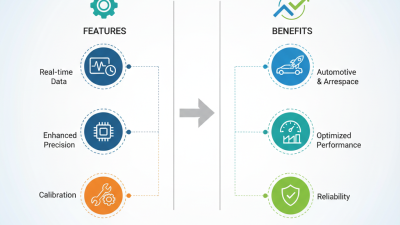
Torque sensors help monitor performance in real-time. They enhance safety while increasing efficiency. Many manufacturers rely on them for quality assurance. For instance, automotive and aerospace industries use Shaft Torque Sensors to ensure product reliability. However, improper calibration can lead to inaccuracies. Companies must invest in regular maintenance to avoid these pitfalls.
Understanding the right applications for a Shaft Torque Sensor is vital. Misapplication can waste resources and diminish product quality. User feedback often indicates confusion about sensor selection. Clear guidelines are needed to improve decision-making. Ultimately, the choice of a Shaft Torque Sensor can significantly impact operational success.
Advantages of Using Shaft Torque Sensors in Various Industries
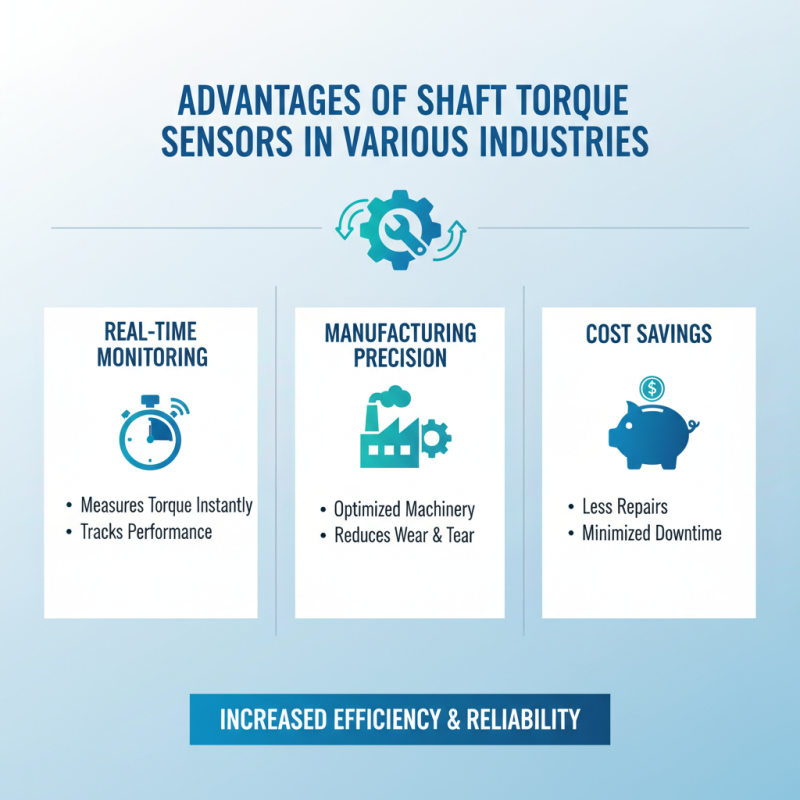
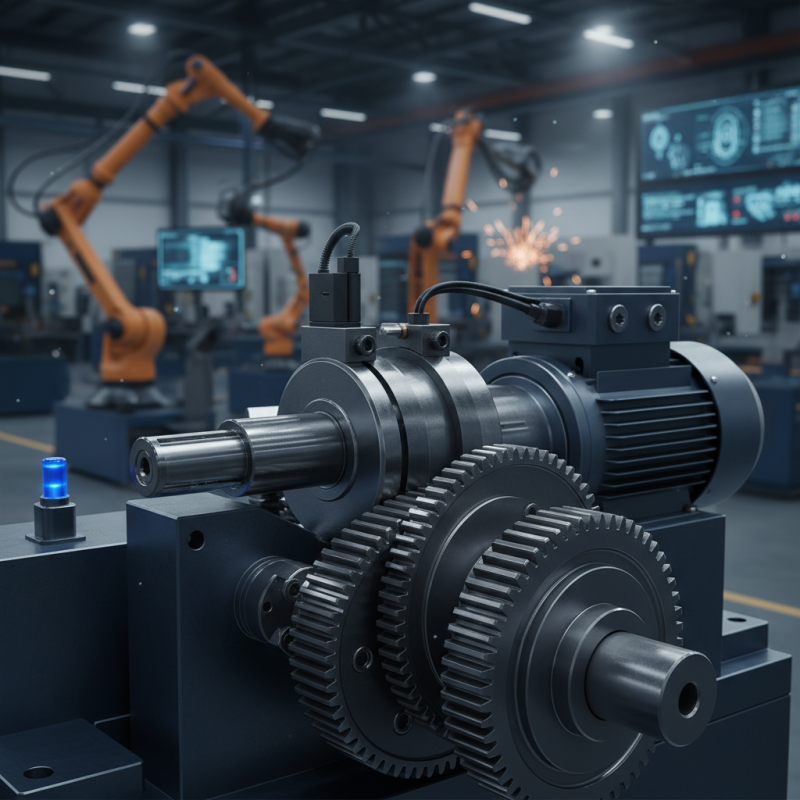
Shaft torque sensors offer numerous advantages across various industries. They measure the torque in real-time, enabling businesses to monitor performance effectively. In manufacturing, precision is crucial. These sensors help ensure that machinery operates within optimal parameters. This minimizes wear and tear, ultimately saving costs on repairs and downtime.
In the automotive industry, torque sensors play a vital role. They allow engineers to test the performance of different components. This testing leads to improvements in safety and efficiency. Real-time data empowers manufacturers to make informed decisions quickly. This can significantly impact product quality and customer satisfaction.
**Tip:** Regular calibration of your torque sensors can enhance their accuracy and longevity.
Moreover, in renewable energy sectors, these sensors monitor the Torque of electric motors in wind turbines. This data helps optimize energy output and maintain performance during varying weather conditions. However, not all setups are straightforward. Each environment necessitates specific configurations and adjustments.
**Tip:** Consider the installation environment when selecting a torque sensor. A well-matched sensor will yield better results.
Frequent performance review of sensors can identify issues before they escalate. With a gradual understanding of sensor capabilities, industries can better utilize this technology. Fine-tuning sensor setups can lead to significant operational enhancements.
Key Applications of Shaft Torque Sensors in Modern Engineering
Shaft torque sensors play a crucial role in various engineering applications. They measure the amount of torque transmitted through a shaft. This measurement is vital for ensuring optimal performance in many mechanical systems.
In automotive engineering, these sensors monitor performance in real-time. They can provide insights into engine efficiency and power distribution. Data from shaft torque sensors help engineers make adjustments, improving vehicle dynamics. In renewable energy systems, they evaluate performance in wind turbines and hydroelectric generators. Monitoring torque helps optimize energy output and ensure system longevity.
Manufacturing and industrial applications also significantly benefit. These sensors help improve machinery performance. They can detect abnormalities early, preventing costly downtime. In robotics, accurate torque measurements enhance control over movements. Feedback from these sensors allows for more precise actions, leading to better product quality. However, integrating these sensors can be complicated. To maximize their usefulness, engineers must tackle installation challenges. Continuous improvements and innovative solutions are necessary for future applications.
Shaft Torque Sensor Applications in Modern Engineering
How Shaft Torque Sensors Improve Precision and Safety in Operations
Shaft torque sensors play a crucial role in enhancing precision and safety in various operations. These sensors measure the torque applied to a shaft, providing real-time data that can optimize performance. With accurate torque readings, operators can fine-tune machinery, reducing wear and tear. This attention to detail leads to longer-lasting equipment, minimizing downtime.
Safety is another critical aspect of using shaft torque sensors. In many applications, excessive torque can lead to catastrophic failures or accidents. Sensors help monitor these thresholds. By alerting operators when torque levels are too high, potential disasters can be avoided. This feature is essential in industries where human safety is paramount, such as manufacturing and automotive.
However, it’s important to acknowledge that not all systems are perfect. Calibration can sometimes be a challenge. Inconsistent data can arise if sensors are not maintained properly. Regular checks and validations are necessary to ensure data accuracy. Operators must be vigilant, as overlooking these details could undermine the benefits of using torque sensors in the first place.
Understanding the Technology Behind Shaft Torque Sensors
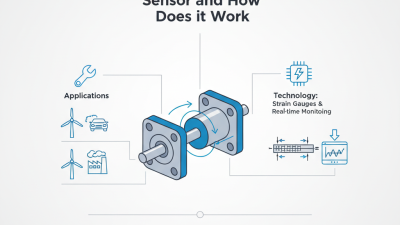
Shaft torque sensors are essential in many industries. They measure the rotational force on a shaft. These sensors operate using various technologies, including strain gauge and magnetoresistive principles. Strain gauges are widely used for their accuracy. They convert torque into an electrical signal, offering real-time feedback.
Understanding the technology behind these sensors is crucial. The design usually involves a metallic element that twists as torque is applied. This twist alters the electrical resistance. Simple and elegant, this technology ensures reliable measurements. However, precision can be affected by temperature fluctuations or mechanical misalignment.
Installation is vital for optimal performance. Misalignment can lead to incorrect readings. Regular calibration is also necessary to maintain accuracy. While shaft torque sensors can be incredibly effective, their performance can vary based on the application. Some environments may pose challenges, like vibration and electromagnetic interference. Understanding these factors is key to successful implementation.
Why Choose a Shaft Torque Sensor for Your Applications?
| Feature |
Description |
Applications |
Benefits |
| High Accuracy |
Provides precise torque measurements. |
Industrial motors, robotics. |
Improved performance and reliability. |
| Real-time Data |
Continuous monitoring of torque levels. |
Automated systems, test rigs. |
Immediate feedback for system adjustments. |
| Compact Design |
Space-saving configuration. |
Limited space applications, automotive. |
Easy integration into existing systems. |
| Wide Measurement Range |
Applicable for various torque levels. |
Manufacturing, aerospace. |
Versatility across different applications. |
| Durability |
Built to withstand harsh environments. |
Oil and gas, heavy machinery. |
Longer lifespan, reduced maintenance costs. |

 sales@loadcellsensor.com